The Kampong Cham National Institute of Agriculture (KNIA) originated from the Kampong Cham University, which was established by His Majesty King Norodom Sihanouk in 1962.
1970-1979
Closure Period
The institute was closed during 1970–1979 due to the civil war, during which most of its infrastructure was severely destroyed.
1989-1991
Reconstruction
The reconstruction of the institute’s facilities took place from 1989 to 1991 through the cooperation of the Royal Government of Cambodia, the Government of Hungary, and LWS (Lutheran World Service and NGO). The rebuilding process was overseen by the Ministry of Education, Youth and Sport (MoEYS) to establish a technical training school.
1992
Transfer to MAFF
In 1992, the technical training school was transferred from the Ministry of Education, Youth and Sport to the Ministry of Agriculture, Forestry and Fisheries (MAFF).
1995
KCNSA Establishment
The Technical Training School became the Kampong Cham National School of Agriculture (KCNSA) in 1995, offering associate degree programs in agriculture. The school was initially launched with three majors in the field of agriculture: Agricultural Science, Animal Science and Veterinary Medicine, and Rubber Crop Science.
2001
Program Expansion
Since 2001, in response to the evolving labor market, the Kampong Cham National School of Agriculture (KCNSA) has expanded its academic programs to five majors: Agricultural Science, Rubber Crop Science, Animal Science and Veterinary Medicine, Fisheries Science, and Agricultural Economics and Rural Development.
2019 – Present
Institutional Transformation
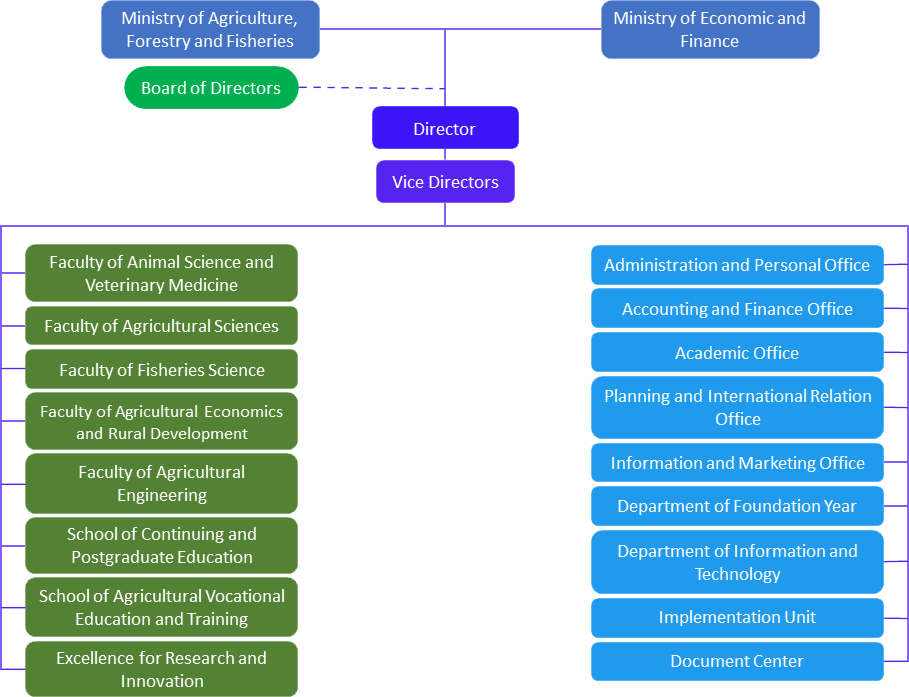
The Kampong Cham National Institute of Agriculture was transformed from the Kampong Cham National School of Agriculture under Sub-Decree No. 146 ANKr.BK, dated 25 September 2019, on the establishment of the Kampong Cham National Institute of Agriculture as a public administrative institution. It operates under the technical supervision of the Ministry of Agriculture, Forestry and Fisheries and the financial supervision of the Ministry of Economy and Finance.
KNIA has continued to strengthen its cooperation with higher education institutions, private companies, and various national development partners.
KNIA has signed a Memorandum of Understanding (MoU) with:
Greenfeed
i7 Ranch
MPTC
PPIU
CWA
Beverages
KNIA has also collaborated with:
DAE of MAFF
CAMBOHUN
International Partners
KNIA partners with international institutions to enhance education, research, and agricultural development through joint projects, exchanges, training, and knowledge sharing.
KNIA has signed a Memorandum of Understanding (MoU) with:
FAO
CaPFISH IT2
NIRAS
CAMBOHUN
Key collaboration partners include:
Including collaboration with the Food and Agriculture Organization (FAO) in the following areas: developing the curriculum of the Faculty of Fisheries Science, building the capacity of government officials and lecturers,
Supporting study visits to target areas under the CaPFish Aquaculture IT2 project and NIRAS