Agronomy Science

Agronomy Science

Genetic Diversity and Association Analyses of Chinese Maize

We selected 68 Chinese maize inbred lines to understand the genetic diversity, population structure, and marker-trait
associations for eight agronomic traits and 50 simple sequence repeats (SSRs) markers. In this study, effective traits, such as days of
anthesis (DA), days of silking (DS), ear height (EH), plant to ear height ratio (ER), plant height (PH), and leaf width (LW) were divided
into PC1 and PC2 by PCA analysis for maize inbred lines. Genetic diversity analysis revealed a total of 506 alleles at 50 SSR loci. The
mean number of alleles per locus was 10.12. The averages of genetic diversity (GD) and polymorphic information content (PIC) values
were 0.771 and 0.743, respectively. Based on a membership probability threshold of 0.80, the population structure revealed that the
total inbred lines were divided into three major groups with one admixed group. A marker-trait association using Q + K MLM showed
that nine SSR markers (bnlg1017, umc2041, umc2400, bnlg105, umc1229, umc1250, umc1066, umc2092, and umc1426) were related
with seven agronomic traits. Among these SSR markers, eight SSR markers were associated with only one agronomic trait (DA, DS,
ER, LL, LW, PH, and ST), whereas one SSR marker (umc1229) was associated with two agronomic traits (DA and ST). These results
will help in optimizing the choice of inbred lines for cross combinations, as well as in selecting markers for further maize breeding
programs.
Agronomy Science

The Gender Variation on The Electroencephalographic Activity in Response to The Exposure of Black Pepper Essential Oil From Kampong Cham, Cambodia

The present study was carried out to investigate the effect of exposure of Cambodian black pepper essential oil on the human electroencephalographic (EEG) activity. In the EEG study, 20 men and 20 women healthy volunteers participated. The EEG readings were recorded from 32 electrodes placed on the scalp according to the International 10-20 system and 25 EEG indices were analyzed. The essential oil of black pepper mainly contains β-caryophyllene (30.53%), 3-carene (19.85%), limonene (14.26%), β-pinene (9.45%), and α-pinene (5.25%). The EEG data showed that the exposure of black pepper essential oil exhibited different brain wave activity according to the gender. In women, a significant increase of spectral edge frequency 50% of alpha at C4 region was observed due to the exposure of black pepper essential oil. In the case of men, relative gamma, the ratio of sensorimotor rhythm to theta, spectral edge frequency 50%, spectral edge frequency 90%, and spectral edge frequency 50% of alpha significantly increased during the exposure of black pepper essential oil. The result revealed that the gender variation plays a major role in the EEG activity of black pepper essential oil and the exposure of black pepper essential oil may improve the cognitive functions.

Agronomy Science

Evaluation of Phytophthoraroot rot and Fusariumwilt in Soybean Cultivars by Hyperspectral Imagery Data

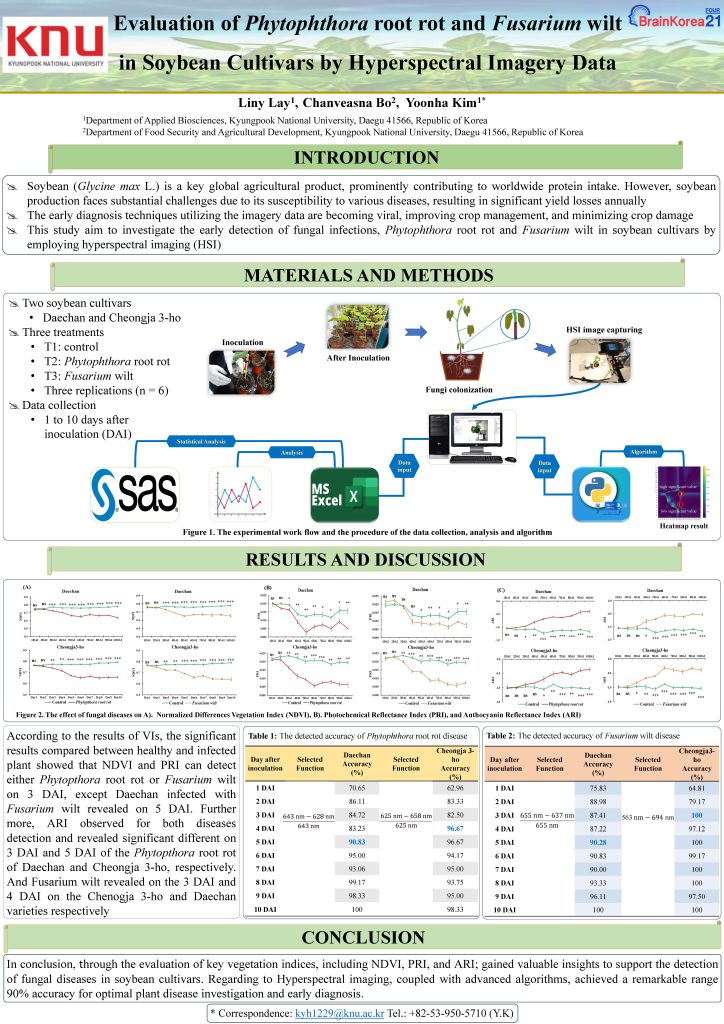
According to the results of VIs, the significant results compared between healthy and infected plant showed that NDVI and PRI can detect either *Phytophthora root rot* or *Fusarium wilt* on 3 DAI, except Daechan infected with *Fusarium wilt* revealed on 5 DAI. Furthermore, ARI observed for both diseases detection and revealed significant different on 3 DAI and 5 DAI of the *Phytophthora root rot* of Daechan and Cheongja 3-ho, respectively. And *Fusarium wilt* revealed on the 3 DAI and 4 DAI on the Chenogja 3-ho and Daechan varieties respectively.

Scroll to Top