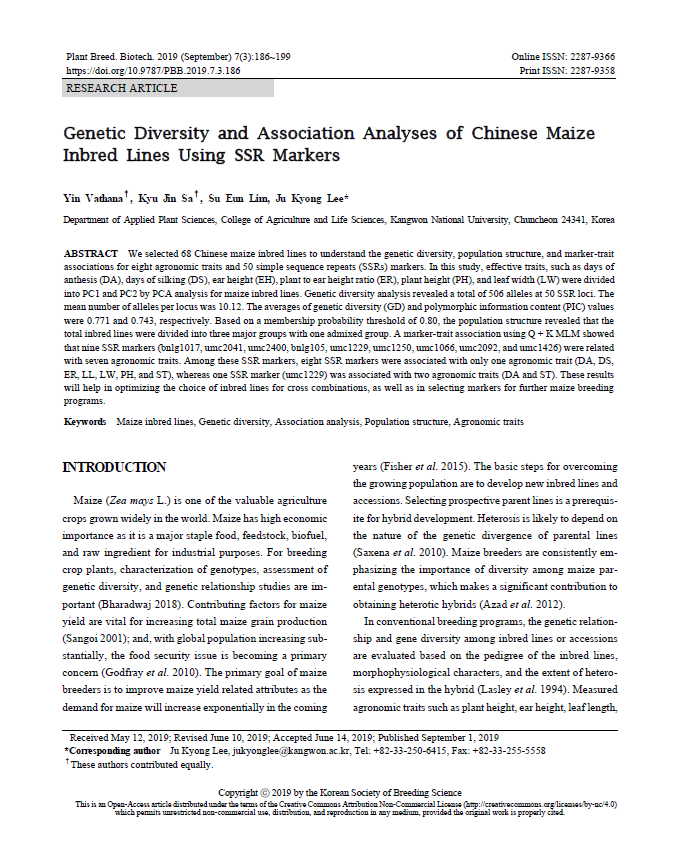
We selected 68 Chinese maize inbred lines to understand the genetic diversity, population structure, and marker-trait
associations for eight agronomic traits and 50 simple sequence repeats (SSRs) markers. In this study, effective traits, such as days of
anthesis (DA), days of silking (DS), ear height (EH), plant to ear height ratio (ER), plant height (PH), and leaf width (LW) were divided
into PC1 and PC2 by PCA analysis for maize inbred lines. Genetic diversity analysis revealed a total of 506 alleles at 50 SSR loci. The
mean number of alleles per locus was 10.12. The averages of genetic diversity (GD) and polymorphic information content (PIC) values
were 0.771 and 0.743, respectively. Based on a membership probability threshold of 0.80, the population structure revealed that the
total inbred lines were divided into three major groups with one admixed group. A marker-trait association using Q + K MLM showed
that nine SSR markers (bnlg1017, umc2041, umc2400, bnlg105, umc1229, umc1250, umc1066, umc2092, and umc1426) were related
with seven agronomic traits. Among these SSR markers, eight SSR markers were associated with only one agronomic trait (DA, DS,
ER, LL, LW, PH, and ST), whereas one SSR marker (umc1229) was associated with two agronomic traits (DA and ST). These results
will help in optimizing the choice of inbred lines for cross combinations, as well as in selecting markers for further maize breeding
programs.